

Quick Response vs Normal Response Sprinklers
A simple, detailed guide for contractors, purchase teams and building owners to understand the difference between Quick Response and Normal / Standard Response sprinkler heads — what changes, where they are used, and what details must be checked before buying.
Quick Response vs Standard Response sprinkler — the difference in one minute
Quick Response sprinklers react faster to heat and are commonly selected for occupied, life-safety-focused spaces such as offices, hotels, hospitals and schools. Normal Response sprinklers, more correctly called Standard Response sprinklers, react comparatively slower and are commonly selected for industrial, warehouse, storage and fire-control applications when the approved design requires them.
First, understand what a sprinkler actually does
Fire sprinklers are automatic heat-operated devices fitted in a fire-fighting sprinkler system. Their job is to discharge water when the surrounding temperature reaches the sprinkler’s rated operating temperature.
A sprinkler normally does not open because of smoke. It opens because of heat. When a fire starts, hot air rises and collects near the ceiling. As the temperature around the sprinkler increases, the heat-sensitive element inside the sprinkler reacts. In most modern sprinkler heads, this element is a small glass bulb filled with liquid. When the liquid expands enough, the bulb breaks, the cap opens, and water is discharged through the sprinkler.
Simple point: both Quick Response and Normal Response sprinklers work on heat. The difference is how quickly their heat-sensitive element reacts to that heat.
Important safety note: This guide is for understanding and buying clarity. Final sprinkler selection should follow the approved fire-fighting drawing, consultant specification, applicable fire code, local authority requirement and manufacturer datasheet.
Visual difference: Quick Response and Normal Response sprinkler
Many sprinkler heads look similar from a distance. The practical difference is usually visible in the thermal element, especially the glass bulb size.
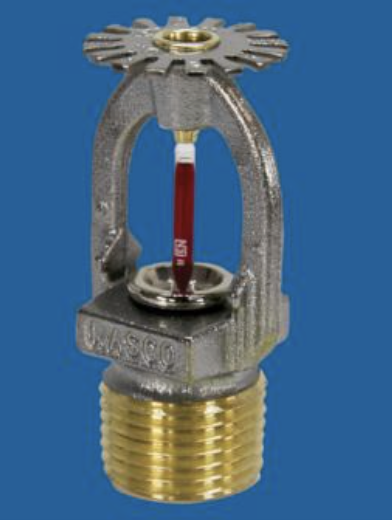
Quick Response Sprinkler
Usually identified by a smaller, faster-reacting thermal element, commonly a 3 mm glass bulb in many models.
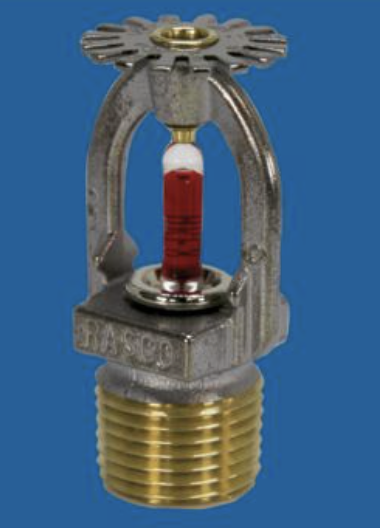
Normal / Standard Response Sprinkler
Generally responds slower than Quick Response sprinklers, commonly seen with a larger 5 mm bulb in many models.
What is a Quick Response sprinkler?
A Quick Response sprinkler, often written as QR sprinkler, is designed to react faster when heat from a fire reaches the sprinkler head. It is part of the fast-response sprinkler category.
The main purpose of a Quick Response sprinkler is generally connected with life safety. That means the sprinkler is intended to control the fire earlier, reduce heat build-up, and help improve conditions for people to evacuate.
Common areas where Quick Response sprinklers are used
What is a Normal Response sprinkler?
A Normal Response sprinkler is commonly called a Standard Response sprinkler in technical specifications. It also opens automatically due to heat, but it responds comparatively slower than a Quick Response sprinkler.
Standard Response sprinklers are commonly used where the design objective is more focused on fire control and property protection, especially in commercial, storage and industrial applications.
Common areas where Normal / Standard Response sprinklers are used
Quick Response vs Normal Response sprinkler: side-by-side difference
The easiest way to understand both sprinkler types is to compare their function, application and selection basis.
| Point | Quick Response Sprinkler | Normal / Standard Response Sprinkler |
|---|---|---|
| Main purpose | Faster response for life-safety-focused spaces. | Fire control and property-protection-focused spaces. |
| Heat sensitivity | More sensitive to heat movement. | Less sensitive compared to Quick Response. |
| Response speed | Reacts faster when hot air reaches the sprinkler. | Reacts comparatively slower. |
| Common bulb size | Often 3 mm glass bulb in many models. | Often 5 mm glass bulb in many models. |
| RTI category | Fast response category, generally lower RTI. | Standard response category, generally higher RTI. |
| Common use | Offices, hotels, hospitals, schools and occupied light hazard spaces. | Factories, warehouses, storage and industrial areas. |
| Selection basis | Consultant design, hazard classification, BOQ and approval requirement. | Consultant design, storage type, fire load, hydraulic design and approval requirement. |
Important: Quick Response is not automatically “better”. It is correct only when the building design and fire consultant specify it.
What is RTI in sprinkler heads?
RTI means Response Time Index. It is a technical measurement used to describe how quickly the heat-sensitive element of a sprinkler reacts to hot air.
You do not need to calculate RTI while placing a normal purchase enquiry, but understanding the meaning helps avoid confusion:
Lower RTI
Means the sprinkler element reacts faster to heat. Quick Response sprinklers fall under this faster-response category.
Higher RTI
Means the sprinkler element reacts slower compared to fast-response sprinklers. Standard Response sprinklers fall under this category.
In simple words, RTI is like the sprinkler’s heat reaction speed. A lower RTI sprinkler senses and reacts to fire heat earlier.
3 mm bulb vs 5 mm bulb: why it matters
One visible difference between many Quick Response and Standard Response sprinklers is the size of the glass bulb.
Quick Response: commonly 3 mm bulb
A smaller bulb heats up faster. This helps the sprinkler respond faster when hot air from the fire reaches the sprinkler head.
Normal Response: commonly 5 mm bulb
A larger bulb generally takes more time to heat, so the sprinkler reacts slower compared to a Quick Response head.
This does not mean the temperature rating is always different. A Quick Response and Standard Response sprinkler can both have the same temperature rating, but the Quick Response unit can still react faster because of its thermal sensitivity.
Temperature rating is different from response type
This is one of the most common misunderstandings in sprinkler selection.
A sprinkler’s temperature rating tells us the approximate temperature at which the sprinkler opens. The response type tells us how quickly the sprinkler’s heat-sensitive element reacts to the heat around it.
Example
Both sprinklers below may have the same operating temperature, but they are not the same in response behaviour.
So while selecting a sprinkler, always check both the response type and the temperature rating.
Which sprinkler should you choose?
The correct sprinkler is not selected only by looking at the product image or size. It must match the approved fire-fighting design.
Quick Response may be suitable when:
- The BOQ or consultant specification mentions Quick Response or QR.
- The area is an occupied light hazard space.
- The design objective includes faster response for life safety.
- The project is a hotel, office, hospital, school, residential-style building or public area.
Normal / Standard Response may be suitable when:
- The BOQ or consultant specification mentions Standard Response or SR.
- The application is industrial, warehouse, storage or manufacturing related.
- The hydraulic design and hazard classification are based on Standard Response sprinklers.
- The existing installed sprinkler is Standard Response and replacement must match the original system design.
Which sprinkler is usually considered for each area?
This table is not a substitute for design approval, but it helps purchase teams understand why the same project may use different sprinkler heads in different areas.
| Area / Application | Common selection direction | Reason |
|---|---|---|
| Office floors | Quick Response | Occupied light hazard spaces where faster response supports life safety. |
| Hotel rooms and corridors | Quick Response | Occupants may be sleeping or unfamiliar with escape routes. |
| Hospitals and healthcare areas | Quick Response | Evacuation can be slower, so early fire control is important. |
| Warehouses and storage rooms | Standard Response or design-specific sprinkler | Depends heavily on storage height, commodity class, rack arrangement and fire load. |
| Factories and industrial sheds | Standard Response or consultant-specified type | Hydraulic design and hazard classification decide the sprinkler. |
| Existing replacement work | Match existing approved design | Replacement should match response type, K-factor, temperature rating, orientation and approval unless redesign is approved. |
Can you replace Standard Response with Quick Response?
Do not replace one response type with another without checking the approved drawing, BOQ, system design and consultant approval.
In sprinkler systems, small differences matter. The replacement sprinkler should match the required:
Common mistakes while buying sprinkler heads
Most site issues happen because the enquiry is incomplete. These are the mistakes that create wrong supply, consultant rejection or replacement delays.
What should be mentioned while buying sprinkler heads?
Many buyers ask only for “15MM sprinkler”. That is not enough for correct supply.
A proper sprinkler enquiry should include:
- Quick Response or Standard Response
- Pendent, upright, sidewall or concealed type
- K-factor
- Temperature rating
- Thread size
- Finish: brass, chrome, white, etc.
- Approval requirement: UL/FM, LPCB, BIS or project-specific approval
- Brand preference
- Quantity
- Project name or BOQ reference, if available
Better enquiry format: Quick Response Pendent Sprinkler, K5.6, 68°C, 15MM thread, chrome finish, UL/FM approved, 250 pcs.
How Vijay Sales Corporation helps with sprinkler requirements
Vijay Sales Corporation has been serving the pipe, valve, fitting and fire-fighting project supply market since 1961. With 60+ years of industry experience, our role is not limited to giving a rate for sprinkler heads. We help contractors, purchase teams and project buyers check whether the sprinkler requirement is commercially clear before quotation, so the supplied material matches the BOQ, consultant schedule and site requirement. We also support fire-fighting product requirements from recognised brands such as NewAge and Lifeguard, along with sprinklers, valves, hose reels, hydrant equipment and related pipeline accessories for project supply.
For fire-fighting projects, a small mismatch in sprinkler type can create delay at site. A Quick Response sprinkler, Standard Response sprinkler, pendent sprinkler, upright sprinkler, sidewall sprinkler or concealed sprinkler may look similar to a layman, but each one can have different approval, K-factor, temperature rating, finish and application. Our team helps buyers convert incomplete enquiries into clear supply requirements before pricing.
60+ years of project supply experience
Established in 1961, Vijay Sales Corporation has long-standing experience in industrial and building-services supply. We regularly handle project enquiries where sprinklers, pipes, valves, fittings, flanges and fire-fighting accessories need to be matched together for one BOQ.
BOQ and specification checking
Share the sprinkler schedule or BOQ and our team can check the key details needed for quote preparation: Quick Response or Standard Response, K-factor, temperature rating, orientation, finish, approval requirement, brand preference and quantity.
Complete fire-fighting pipeline support
Along with sprinkler heads, we can support related fire-fighting products such as butterfly valves, gate valves, check valves, hydrant valves, hose boxes, pipes, pipe fittings, flanges, strainers and project accessories.
Practical buying support
Many enquiries come with only size and quantity. We help identify what is missing before the quotation stage, reducing wrong selection, approval mismatch and repeated clarification during site procurement.
Fire-fighting brands and related product pages
For fire-fighting project requirements, buyers often need sprinkler heads along with hose reels, hydrant equipment, valves and accessories from recognised fire-fighting brands. You can also explore our dedicated brand pages for NewAge and Lifeguard fire-fighting products.
Best way to ask for a quote: send your BOQ or mention sprinkler response type, orientation, K-factor, temperature rating, approval requirement, finish and quantity. This allows Vijay Sales Corporation to prepare a cleaner and faster quotation for your project.
Final conclusion
Quick Response and Normal Response sprinklers both protect against fire, but they are designed with different response behaviour.
A Quick Response sprinkler reacts faster to heat and is commonly used where life safety and early fire control are important.
A Normal / Standard Response sprinkler reacts slower compared to Quick Response and is commonly used in industrial, storage and property-protection-focused applications.
The right sprinkler should always be selected as per the approved fire-fighting drawing, hazard classification, consultant specification, local authority requirement and manufacturer datasheet.
Frequently asked questions
What is the main difference between Quick Response and Normal Response sprinklers?
The main difference is heat sensitivity. Quick Response sprinklers react faster to heat, while Normal or Standard Response sprinklers react comparatively slower.
Does Quick Response mean lower temperature?
No. Quick Response does not automatically mean lower temperature. A Quick Response sprinkler and a Standard Response sprinkler can have the same temperature rating.
Where are Quick Response sprinklers used?
They are commonly used in occupied and light hazard spaces such as offices, hotels, hospitals, schools, corridors and similar areas.
Where are Normal Response sprinklers used?
They are commonly used in warehouses, factories, industrial buildings, storage areas and spaces where the design focuses on fire control and property protection.
Can I replace a Standard Response sprinkler with Quick Response?
Not without checking the approved fire-fighting design. Replacement should match the required response type, K-factor, temperature rating, orientation, finish and approval.
Which sprinkler is better?
Neither is universally better. Quick Response is better for certain life-safety applications, while Standard Response is better for certain industrial or storage applications.
What details should I send for sprinkler pricing?
Send response type, pendent/upright/sidewall/concealed type, K-factor, temperature rating, finish, approval requirement, brand preference, quantity and project location.
Is Normal Response the same as Standard Response?
Yes. In normal buying language, people may say Normal Response sprinkler, but in technical specifications it is generally referred to as Standard Response sprinkler.
Need Quick Response or Normal Response Sprinklers?
Share your sprinkler schedule or BOQ. Vijay Sales Corporation can help you prepare a clearer enquiry for sprinkler heads, fire-fighting valves and related project material.