Jindal SS Pipes — SS 304 & SS 316, ERW & Seamless
Genuine Jindal SAW / Jindal Quality Tubular Limited stainless steel pipes — ready stock at our Delhi warehouse. ASTM A312 SS-304/SS-304L and ASTM TP316/316L.
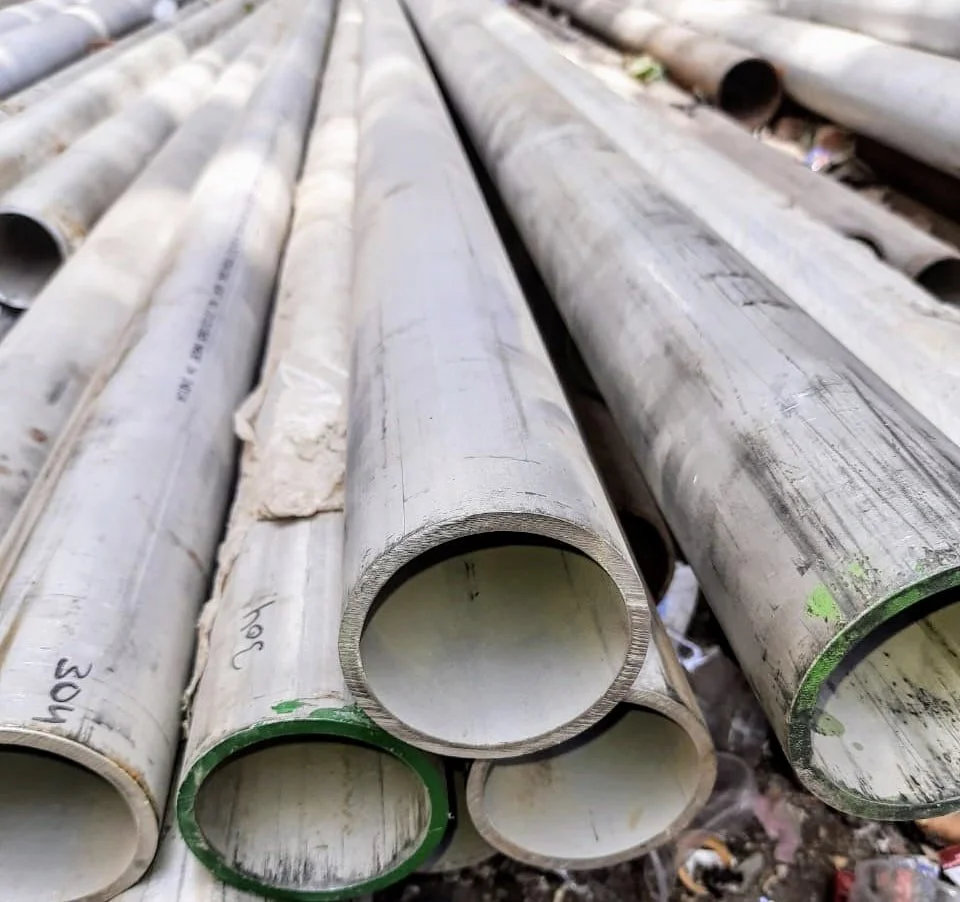
Who Manufactures Jindal SS Pipes?
Establishing the manufacturing chain behind every Jindal stainless steel pipe.
What Jindal SS Pipes We Stock
Three live price lists covering ERW and seamless variants in SS 304 and SS 316.
Jindal SS 304 ERW Pipes
ASTM A312 SS-304 / SS-304L
Sizes ½" to 16"
Schedule 10 & 40
Best for: general industrial water, food & dairy, mild process service.
Jindal SS 304 Seamless Pipes
ASTM A312 SS-304 / SS-304L
Sizes ½" to 8"
Schedule 10 / 40 / 80
Best for: high-pressure process lines, IBR-governed steam, sour service.
Jindal SS 316 ERW Pipes
ASTM TP316 / TP316L
Sizes ½" to 12"
Schedule 10 & 40
Best for: chloride exposure, coastal/marine, chemical and pharma service.
Get a Quote for Jindal SS Pipes
Ready to inquire? Send us your spec — quote in 3-4 working hours via WhatsApp or email.
SS 304 Pipe Specifications & Properties
Chemistry, mechanical properties, and the difference between standard 304 and the low-carbon 304L variant — per ASTM A312 TP304/TP304L.
Chemical Composition (per ASTM A312 TP304)
SS 304 is the most widely used austenitic stainless steel grade. The chemistry is balanced to deliver a self-healing chromium-oxide passive layer (corrosion resistance), an austenitic crystal structure (formability and low-temperature toughness), and consistent welding behaviour. The 304L variant lowers carbon to prevent carbide precipitation at the weld zone — important for fabricated piping with multiple field welds.
| Chromium (Cr) | ~18–20% |
|---|---|
| Nickel (Ni) | ~8–10.5% |
| Carbon (C) — standard 304 | max 0.08% |
| Carbon (C) — 304L (low-carbon) | max 0.03% |
| Manganese (Mn) | max 2% |
| Silicon (Si) | max 1% |
| Phosphorus (P) | max 0.045% |
| Sulphur (S) | max 0.03% |
| Iron (Fe) | balance |
Chromium does the heavy lifting on corrosion resistance — the passive oxide layer reforms continuously when scratched. Nickel stabilises the austenite phase and contributes to formability and impact toughness even at cryogenic temperatures. The 304L low-carbon limit (max 0.03% C) prevents chromium carbides from precipitating at grain boundaries during welding, which would otherwise leave the weld zone vulnerable to intergranular corrosion in service. For fabricated piping, 304L — or dual-certified 304/304L material — is usually the safer specification.
Mechanical Properties (typical, per ASTM A312)
SS 304 strikes a balance between strength, ductility, and toughness. The values below are ASTM A312 minimums; mill-supplied JQTL pipes typically run somewhat higher and report actual values on the Test Certificate dispatched with each consignment.
| Tensile strength | ~515 MPa minimum |
|---|---|
| Yield strength (0.2% offset) | ~205 MPa minimum |
| Elongation in 50 mm | ~35% minimum |
| Hardness | Rockwell B max 92 / Brinell max 201 |
Note that 304's strength is not its key selling point — many carbon steels are stronger. SS 304 is specified for its corrosion behaviour, hygienic surface, and resistance to oxidation at elevated temperatures. If your application needs higher mechanical strength but doesn't need stainless corrosion resistance, carbon-steel alternatives are usually more cost-effective.
When to Specify 304 vs 304L
Standard SS 304 is sufficient for most general industrial, food and beverage, and water-process applications. It accepts standard welding without special precautions where weld passes are limited and the welded joint will not see heavy thermal cycling in service.
SS 304L (low-carbon) is preferred where multiple field welds are required, where the service involves repeated thermal cycling (boiler-feed return lines, jacketed reactors, steam-jacketed kettles), or where post-weld heat treatment is impractical. The lower carbon content reduces the risk of sensitisation — the precipitation of chromium carbides at grain boundaries that locally depletes chromium and creates intergranular corrosion paths.
Dual-certified ASTM A312 TP304/TP304L pipe is common in the market — meeting both standards simultaneously. JQTL pipes are typically dual-certified, so a single material satisfies either specification on the procurement order. When in doubt, specify dual-cert: it costs no more and gives the fabricator flexibility.
SS 316 Pipe Specifications & Properties
The molybdenum-bearing grade for chloride-rich and chemically aggressive service — per ASTM TP316/TP316L.
Chemical Composition (per ASTM TP316/TP316L)
SS 316 looks similar to 304 on the surface but carries a critical addition: molybdenum. The Mo content is what separates 316 from 304 in service performance, and it's why 316 commands a meaningful price premium — molybdenum is significantly more expensive per kg than the chromium and nickel that dominate 304's chemistry.
| Chromium (Cr) | ~16–18% |
|---|---|
| Nickel (Ni) | ~10–14% |
| Molybdenum (Mo) | ~2–3% — key differentiator from 304 |
| Carbon (C) — standard 316 | max 0.08% |
| Carbon (C) — 316L (low-carbon) | max 0.03% |
| Manganese (Mn) | max 2% |
| Silicon (Si) | max 1% |
| Phosphorus, Sulphur, Iron | per standard |
The 2–3% molybdenum content is what gives SS 316 its chloride resistance. In coastal atmospheres, brine service, swimming-pool chemistry, and chemical processing involving chlorides, the molybdenum addition is the difference between a 5-year service life on SS 304 and a 25-year service life on SS 316. The slightly higher nickel content in 316 (vs 304) also helps stabilise the austenite phase against the influence of the added molybdenum.
Mechanical Properties (typical)
SS 316 mechanical properties are very similar to SS 304 — both are austenitic stainlesses with comparable strength and ductility. The grade upgrade is a corrosion-resistance upgrade, not a strength upgrade.
| Tensile strength | ~515 MPa minimum |
|---|---|
| Yield strength (0.2% offset) | ~205 MPa minimum |
| Elongation in 50 mm | ~35% minimum |
| Hardness | similar to 304 |
This means 316 trades higher cost (mostly nickel and molybdenum) for corrosion resistance, not for higher mechanical strength. If your specification calls out 316 purely for "stronger" stainless, that's almost always a misspecification. If your specification is silent on grade and the service environment is benign (no chlorides, no aggressive chemicals), SS 304 gets you there at roughly 60-70% lower cost per metre on ERW.
When to Specify 316 vs 316L
SS 316L (low-carbon) is the welded-fabrication standard for refinery, chemical, and pharmaceutical piping. The lower carbon limit (max 0.03%) protects against intergranular corrosion at the weld zone — important for stainless piping in corrosive service that already lives close to its limits. Most field-fabricated 316 piping is specified as 316L for this reason.
Standard SS 316 is used where welding is minimal or done in shop with proper post-weld solution treatment. It's also acceptable where service is corrosive but not at the threshold where intergranular corrosion is the dominant failure mode.
Most JQTL stock is 316L or dual-certified 316/316L, so a single material satisfies either spec on the purchase order. When in doubt, specify dual-cert — it gives the fabricator flexibility and protects against accidental sensitisation during welding.
Understanding Pipe Schedules — SCH 10, 40, 80
A pipe schedule defines the wall thickness for a given Nominal Bore (NB). For the same NB, higher schedule = thicker wall = higher pressure rating but smaller internal flow area. Schedule numbers are size-relative — a 1" SCH 40 has different mm wall thickness than a 6" SCH 40, but the same relative pressure rating. The reference chart below covers the most-stocked sizes.
Which Grade Should You Choose — SS 304 or SS 316?
Both SS 304 and SS 316 are austenitic stainless steels with excellent corrosion resistance. SS 316 contains 2-3% molybdenum which gives it superior resistance to chlorides and aggressive chemicals. The price premium for SS 316 over SS 304 is roughly 60-70% for ERW pipes — the additional cost is justified only when the application demands it.
| Application | SS 304 | SS 316 |
|---|---|---|
| General industrial water lines | ✓ Sufficient | Overspecified |
| Boiler feed (non-IBR) | ✓ Sufficient | Overspecified |
| Food / dairy / pharma (no chlorides) | ✓ Sufficient | Optional upgrade |
| Coastal / marine atmosphere | Limited | ✓ Recommended |
| Chemical processing (chlorides) | Avoid | ✓ Recommended |
| Pharma with cleaning chemicals | Limited | ✓ Recommended |
| High-purity hydrogen peroxide | Avoid | ✓ Required |
| Refinery sour service | Avoid | ✓ Required |
If you're not sure which grade fits your application, share the spec or process details on WhatsApp and we'll confirm the right grade and schedule before quoting.
ERW or Seamless? How to Choose
The right construction depends on pressure rating, service type, and size availability.
Choose ERW when…
- General industrial water and process lines under moderate pressure
- Cost-sensitive applications where Schedule 10/40 wall thickness suffices
- Sizes 14"–16" where seamless options are limited
- Applications not requiring full-radiography sour service
Choose Seamless when…
- High-pressure process lines requiring Schedule 80 wall thickness
- Sour service, hydrogen service, or high-cycle applications
- Critical pharma or food lines where weld-line porosity is a concern
- Smaller bore (½" to 8") for refinery, fertiliser, or boiler service
How Jindal ERW & Seamless SS Pipes Are Made
Buyers often ask whether ERW or seamless is “better.” Neither is universally better — they're made from different starting materials by fundamentally different processes, and each has applications where it's the correct choice. Here's how each is manufactured at Jindal SAW / JQTL plants.
ERW (Electric Resistance Welded) Pipes
- Starts from coiled stainless steel strip — typically supplied by mills like JSL or comparable cold-rolled stainless producers.
- Strip is uncoiled, edge-trimmed and progressively formed into a cylinder by a series of roller-forming machines that gradually bend the flat strip into a tube shape.
- The longitudinal seam is welded by TIG, plasma, or laser welding — JQTL's Kosi Kalan plant uses TIG/plasma/laser depending on grade and wall thickness.
- The weld bead is ground or polished to match the parent metal, so the finished pipe has a uniform surface inside and out.
- Pipe is solution-annealed in a continuous bright-annealing furnace under inert gas atmosphere to restore the corrosion-resistant chromium-oxide layer disturbed by welding.
- Hydrostatically tested, eddy-current tested, and ultrasonic-tested for weld integrity.
- Final cut to length, marked with size/grade/heat-no, and packed for dispatch.
Seamless Pipes
- Starts from a solid stainless steel billet — round bar of the target grade.
- Billet is heated and pierced into a hollow shell (the “mother hollow”) using Mannesmann piercing or a similar rotary-piercing process. This is the moment a solid bar becomes a tube — with no weld seam, by definition.
- The hollow is then either cold-drawn over a mandrel using the cold-pilger process (used at Kosi Kalan for tighter tolerances and smaller bores) or hot-extruded (Nagothane plant) to achieve the final OD-to-wall ratio.
- Solution-annealed, bright-annealed, or pickled-and-passivated depending on grade and finish requirement.
- Hydrostatically tested, NDT, ultrasonic, and dimensional checks.
- Cut to length, marked with size/grade/heat-no, and packed.
Why Buyers Source Jindal SS Pipes from VSC
Four reasons procurement teams across Indian industry put VSC on speed-dial for Jindal stainless steel pipes.
Genuine Jindal SAW Material
Every Jindal SS pipe shipment from our Delhi warehouse comes with a Test Certificate from Jindal SAW / Jindal Quality Tubular Ltd — verifying chemical composition, mechanical properties, and heat number traceability.
Ready Stock in Delhi
We hold ready stock at our Hauz Qazi warehouse covering the full standard range — ½" to 16" ERW and ½" to 8" seamless. Most orders ship the same or next business day.
Quote in 3-4 Hours
Send your requirement on WhatsApp 9999889008 — you'll have a tailored quote with cost-to-doorstep within 3-4 working hours on business days.
Consulting on Spec
Not sure between SS 304 vs 316, ERW vs seamless, or which schedule fits your pressure? Our team helps you confirm the right spec before quoting — saves rework later in your project.
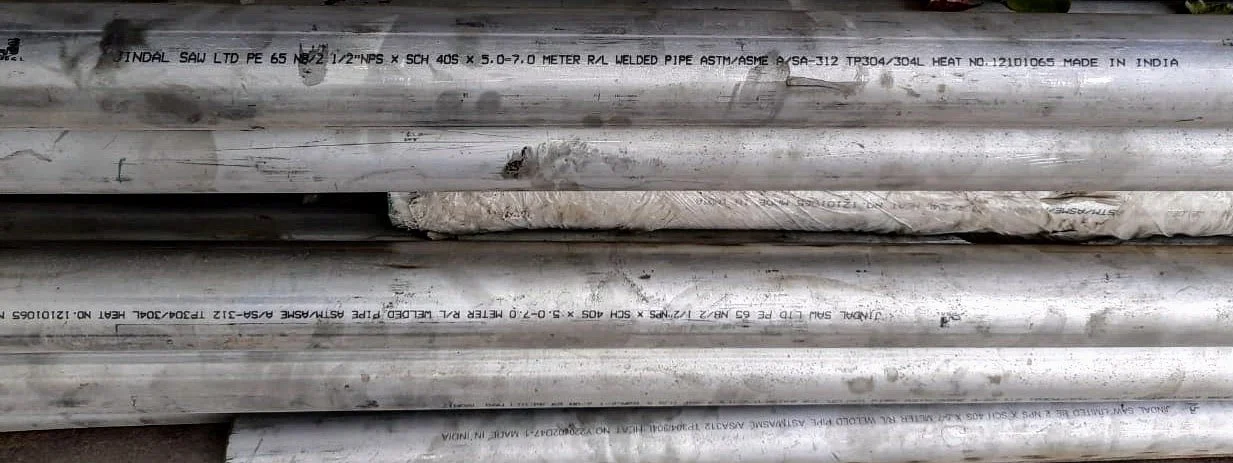
Lead Time, Delivery & Stock Position
How VSC turns a WhatsApp inquiry into a delivered pipe — ex-stock for standard sizes, mill-direct for larger or non-standard orders.
Delhi Warehouse Stock (Ex-Stock)
Standard ERW and Seamless ranges in Jindal SS 304 are held in ready stock at our Hauz Qazi warehouse, along with the SS 316 ERW range. Most orders ship the same business day or the next:
- Small orders (1–50 pipes): same-day or next-day dispatch on stocked sizes.
- Medium orders (50–500 pipes): typically dispatch within 3–5 business days, subject to ready-stock confirmation at the time of order.
- Stocked sizes are confirmed on a per-quote basis — large or unusual sizes are checked against current stock before we commit.
Mill-Direct (Indent) Supply
For very large orders, non-standard sizes (above 16"), or special schedules and grades, VSC arranges mill-direct supply from JQTL:
- Indent lead time is typically 4–8 weeks depending on grade, mill load, and current order book at JQTL.
- Indent pricing can be 5–10% lower than ex-stock for large quantities — buyers with project planning horizons benefit from indent procurement.
- VSC handles all liaison, dispatch coordination, and Test Certificate procurement on indent orders end-to-end — you don't deal with the mill directly.
Cut-Length and End Finish
Standard mill lengths are 6.10 metres for ERW and 5–7 metres for seamless (random lengths). For applications that need specific cut lengths:
- Cut-to-size service available on request — typical surcharge applies for cutting and re-deburring.
- End finish: Plain End (PE) is standard. Bevel End (BE) preparation for butt-weld applications available on request.
- Short cut-pieces from inventory leftovers occasionally available at favourable rates — ask at quote stage.
Logistics & Documentation
Pan-India dispatch is handled via standard transport partners. Cartage and freight are billed at actuals based on destination — we share the freight quote with you before dispatch so there are no surprises. Standard documentation supplied with every shipment:
- Tax invoice and e-way bill
- Mill Test Certificate (MTC) covering chemistry, mechanicals, and heat-number traceability
- Packing list with pipe-wise size, length, and quantity breakdown
- Dispatch advice with truck details and expected delivery date
Documents & Specifications
Catalogue, technical data sheets, and a sample test certificate — for project submittals and procurement reference.
Jindal SAW SS Pipes Catalogue
Full product range, manufacturing process, and certification details.
Download CatalogueJindal SAW SS ERW Pipes TDS
Technical data sheet — ASTM A312 SS-304 ERW specifications.
Download ERW TDSJindal SAW SS-304 Seamless Pipes TDS
Technical data sheet — ASTM A312 SS-304/304L seamless specifications.
Download Seamless TDSSample Test Certificate
Example TC from Jindal SAW / JQTL covering chemistry, mechanicals, and heat traceability.
Download Sample TCWhere Jindal SS Pipes Are Manufactured
JQTL produces stainless steel pipes across multiple Jindal SAW facilities. Each plant specialises in different product types and sizes, all under unified Jindal SAW quality and certification systems.
Kosi Kalan, UP
Pipe Forming Mill (TIG/Plasma/Laser welding), JCO Press, X-Ray Radiography, Ultrasonic Testing.
Samaghogha, Kutch
Pipe Forming Mill, JCO Press, Cold Pilger, Hydrostatic Testing.
Nagothane, Maharashtra
Hot Extrusion, Hot Expander, NDT, Hydrostatic Testing.
Nashik, Maharashtra
Rotary Hearth Furnace, PQF Mill, Walking Beam Furnace, EMI/UT testing systems.
What to Include When Requesting a Quote
The clearer your specification, the faster and more accurate the quote. When requesting Jindal SS pipe pricing on WhatsApp or email, include the following details — this checklist covers everything our team needs to confirm price, stock and lead time on the first message.
-
Grade & Variant
SS 304, SS 304L, SS 316, SS 316L, or dual-certified — and whether you need ERW or Seamless. If you're unsure between grades, mention the service environment (chemical, water, food, marine, etc.) and we'll advise.
-
Size — NB and Schedule
For example, “50 NB SCH 40” fully specifies both OD and wall thickness for ASTM A312. NB is the nominal bore (size class); Schedule defines the wall thickness.
-
Quantity (in metres or number of pipes)
Standard length is 6.10 m for ERW and 5–7 m for seamless. Specify “cut length” if you need non-standard lengths and we'll quote with cutting included.
-
End Finish
Plain End (PE) is standard. Specify “Bevel End” (BE) if your application requires butt-weld preparation; bevel cutting attracts a small surcharge but saves field-prep time.
-
Test Certificate Requirement
Mill Test Certificate (MTC) is supplied as standard with every dispatch. Mention if you also need third-party inspection (TPIA), NACE certification, PMI testing, or any additional spec-specific tests so we can quote those costs separately.
-
Delivery Location & Timeline
Where in India? When do you need it on site? This helps us route correctly — ex-stock from Delhi for standard sizes, or mill-direct indent for large/non-standard orders — and give you a realistic delivery commitment.
-
Project Tagging (if applicable)
Some EPC and government projects require pipe stencilling or marking with project reference, PO number, or heat-number traceability beyond the standard mill marking. Flag this at quote stage so we can confirm with the mill before commitment.
Industries Using Jindal SS Pipes
Where Jindal stainless steel pipes are specified across Indian industry.
- Oil & Gas (exploration, refining, petrochemicals)
- Power generation (thermal, nuclear, hydro)
- Pharmaceutical and biotechnology
- Food, dairy, and beverage processing
- Chemical and petrochemical
- Fertilizer plants
- Sugar and distillery
- General mechanical engineering
- Heat exchanger and boiler tube applications
- Cryogenic services
Frequently Asked Questions — Jindal SS Pipes
Answers to procurement and brand-disambiguation questions from buyers researching Jindal SS pipe options.
Who manufactures Jindal SS pipes?
Jindal SS pipes are manufactured by Jindal Quality Tubular Limited (JQTL), the stainless steel pipe arm of Jindal SAW Limited. Jindal SAW is part of the O.P. Jindal Group. Manufacturing happens at the Kosi Kalan, Samaghogha, Nagothane, and Nashik facilities.
Is Jindal SAW the same as JSL or Jindal Stainless?
No. Jindal SAW Ltd. (which makes JQTL stainless pipes) is part of the O.P. Jindal Group, led by Prithavi Raj Jindal. Jindal Stainless (JSL) is a separate company in the same family group, led by Ratan Jindal — JSL primarily makes stainless steel coil and sheet, not pipe. For SS pipes specifically, Jindal SAW / JQTL is the correct reference.
What grades and sizes are available?
VSC stocks Jindal SS 304 ERW (½" to 16", Schedule 10 & 40), SS 304 Seamless (½" to 8", Schedule 10/40/80), and SS 316 ERW (½" to 12", Schedule 10 & 40). All conform to ASTM A312 SS-304/304L for grade 304 and ASTM TP316/316L for grade 316.
Are Jindal SS pipes IBR approved?
Yes. The Kosi Kalan facility holds IBR certification, which means Jindal SS pipes can be used in IBR-governed steam, boiler feed, and pressure-vessel applications subject to project-specific approval.
Can I get a sample Test Certificate?
Yes. Every Jindal SS pipe shipment from VSC ships with a Test Certificate from Jindal SAW / JQTL covering chemistry, mechanical properties, and heat number traceability. A sample TC is available for download from the Documents section above.
How quickly can I get a quote?
WhatsApp your requirement to 9999889008 — you'll have a tailored quote with cost-to-doorstep within 3-4 working hours on business days.
Do you ship outside Delhi?
Yes. Most orders are dispatched from our Hauz Qazi warehouse in Delhi to PAN-India destinations. Cartage and freight charged at actuals based on destination.
What is the difference between SS 304 and SS 316?
Both are austenitic stainless steels. SS 316 contains 2-3% molybdenum which gives it superior corrosion resistance against chlorides and aggressive chemicals — making it the right choice for coastal, marine, chemical processing, and pharma applications. SS 304 is sufficient for general industrial water and process lines and costs roughly 60-70% less for ERW. See the comparison table above.
Things Buyers Often Get Wrong About SS Pipes
Five clarifications that prevent costly procurement mistakes — and avoid the wrong material arriving on site.
Are “stainless steel” pipes all the same grade?
No. “Stainless steel” covers dozens of grades. SS 202, SS 304, SS 304L, SS 316, SS 316L, SS 310, SS 321, SS 904L all have different chemistry, corrosion behaviour and price. Always specify the grade — “SS pipe” alone is not a complete spec.
Can I substitute SS 304 with SS 304L?
Usually yes — 304L meets all the requirements of 304 plus better weldability, and many mill heats are dual-certified to both. The reverse is NOT always safe: don't substitute a 304L specification with standard 304 without first confirming that the application can tolerate the higher carbon content during welding.
Is Jindal SAW the same as Jindal Stainless (JSL)?
No. Jindal SAW makes pipes — JQTL is its stainless pipe arm. Jindal Stainless / JSL primarily makes stainless coil and sheet, not finished pipes. Both companies are part of the O.P. Jindal Group but are different operating businesses with different leadership. For SS pipes, specify Jindal SAW / JQTL.
Does seamless mean better quality than ERW?
Not automatically. ERW pipes from quality mills like JQTL go through the same NDT, hydrostatic, and ultrasonic testing as seamless. The choice should be based on the application's pressure, service, and spec — not on a general assumption that seamless is “better.”
Can I order small quantities of Jindal SS pipes?
Yes. VSC's ready-stock model means single-pipe to truckload-scale orders are all supported. There is no MOQ for ex-stock supply — whether you need one pipe for a repair or 500 for a project, we ship from Delhi inventory. Indent (mill-direct) orders typically have larger MOQs and longer lead times.
Request a Detailed Quote
Read everything? Use this form for a more detailed inquiry — we'll respond within 3-4 business hours with confirmed rates, stock position, and freight estimate.
Ready to Source Jindal SS Pipes?
Genuine Jindal SAW material • Ready stock in Delhi • Quote in 3-4 hours.